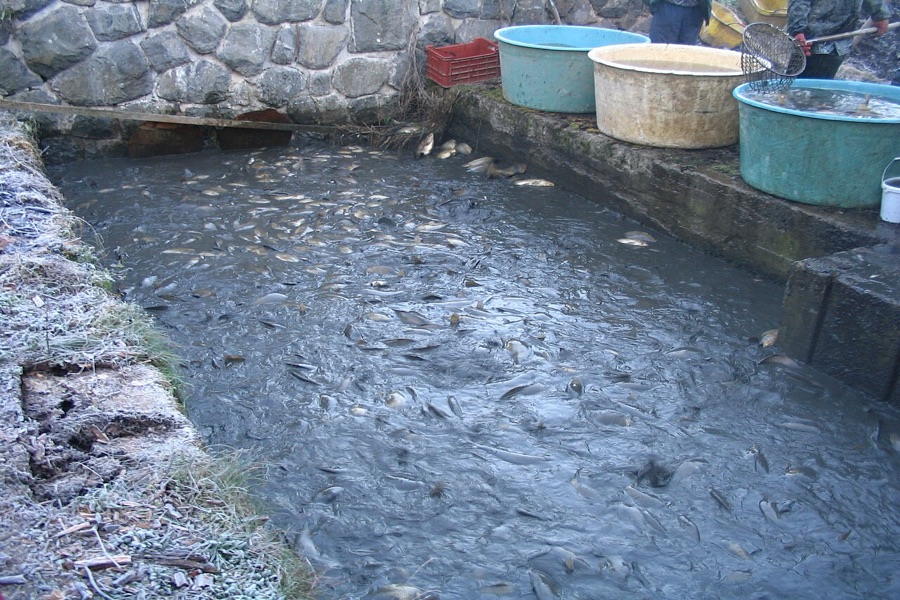
If your fish are suddenly swimming with their fins folded tight against their bodies instead of spread open, you are looking at one of the most useful early warning signs in fish farming. Farmers call it "clamped fins," and it almost always means the fish is uncomfortable. What it does not tell you by itself is why — and that distinction is what separates a cheap fix from an expensive guessing game.
What Clamped Fins Actually Look Like
A relaxed, healthy fish cruises with its fins partly open: tail fin gently fanning, pectoral fins out and steering. A fish with clamped fins holds them flat and tight, as if trying to make itself smaller. Once you have seen it, the change is obvious — the fish looks stiff, moves less, and often holds position in one spot or hangs near the surface or the bottom. It is one of several early posture changes covered in how to recognize stress in farmed fish, and it usually shows up before more dramatic signs do.
The Most Common Causes
Clamped fins are a response, not a condition. The causes farmers most often find behind it:
- Water quality irritation. Elevated ammonia or nitrite, or a sudden pH swing, irritates skin and gills. This is the first thing to rule out because it is common, fast-moving, and measurable — see how to recognize ammonia problems in fish farming for the classic signs.
- Temperature stress. A fast change of a few degrees — a cold night, a hot afternoon on a shallow pond, or new water added too quickly — can clamp fins across many fish at once.
- Low dissolved oxygen. Fish stressed by low oxygen clamp fins, gather near inflows or aerators, and may progress to gasping.
- External irritation. Skin and gill parasites often start with clamped fins and flicking movements before any visible spot or sore appears.
- Crowding and social stress. Overstocked fish and newly mixed groups clamp fins under constant social pressure.
- Handling aftermath. Fish clamp fins for a day or so after netting, grading, or transport; that alone is normal if it resolves.
Narrow It Down by Pattern
Three questions do most of the diagnostic work. First: how many fish? Nearly the whole pond clamping at once points at water or temperature; a few scattered fish points at parasites, injury, or individual weakness. Second: how fast? A change since yesterday points at a sudden stressor — a water change, a storm, a new fish batch. A gradual spread over days suggests something multiplying, like a parasite. Third: what else changed? Clamped fins plus flashing and rubbing suggests external irritation; plus refusing feed suggests a stronger stressor; plus deaths escalates urgency.
Check the Water Before Anything Else
Whatever the behavior suggests, run the water tests first — dissolved oxygen, ammonia, nitrite, pH, and temperature. Water problems are the most common cause, they are cheap to confirm or eliminate, and a water problem plus any second problem at once is the combination that turns into an overnight kill. Test in the early morning if you can; that is when oxygen is lowest and problems are most visible.
What You Can Do Right Away
If a water test shows a problem, fix the water — that resolves most clamped-fin cases within a day or two. If the water checks out, reduce stress: keep feeding light, avoid handling or netting, and watch whether new signs develop. Resist reaching for a treatment on posture alone; clamped fins accompany too many unrelated causes for any single remedy to be a safe guess.
When It Is More Than a Bad Day
Get a qualified aquatic animal health professional or your local aquaculture extension service involved when clamped fins persist for several days with clean water, spread steadily through the pond, or come with deaths, surface sores, or fish refusing feed. A skin or gill scrape under a microscope settles most parasite questions quickly — and it is the difference between treating the real cause and spending money on the wrong one.