Dissolved oxygen is the most critical, fast-changing water quality variable in pond aquaculture. Unlike land animals, farmed fish live in a medium that holds very little oxygen by weight—and warm water holds even less than cool water. Understanding what consumes oxygen in a pond allows operators to anticipate drops before fish begin suffocating.
What Could Be Causing This?
In most earthen and lined aquaculture ponds, oxygen depletion is driven by a combination of biological and weather factors:
- Dense phytoplankton blooms at night: Microscopic algae produce oxygen during sunny afternoons, but at night those same algae respire and consume oxygen. Often, phytoplankton and sediment bacteria consume more oxygen overnight than the fish themselves.
- Cloudy, windless days after hot, sunny weather: When heavy cloud cover blocks sunlight after several bright days, algal oxygen production drops sharply while respiration by fish, algae, and warm pond mud continues at full speed.
- Sudden phytoplankton die-offs ("bloom crash"): When a dense green bloom suddenly dies, bacteria multiply rapidly to decompose the dead algae, stripping dissolved oxygen from the water column and turning the pond brown or gray.
- Overfeeding and organic sludge accumulation: Uneaten feed pellets and fish waste settle to the pond bottom, creating high biological oxygen demand (BOD) in the sediment.
- Pond turnover after cold rain or strong wind: Heavy rain or wind can break thermal stratification, mixing anoxic (oxygen-free) bottom water into the upper layer where fish live.
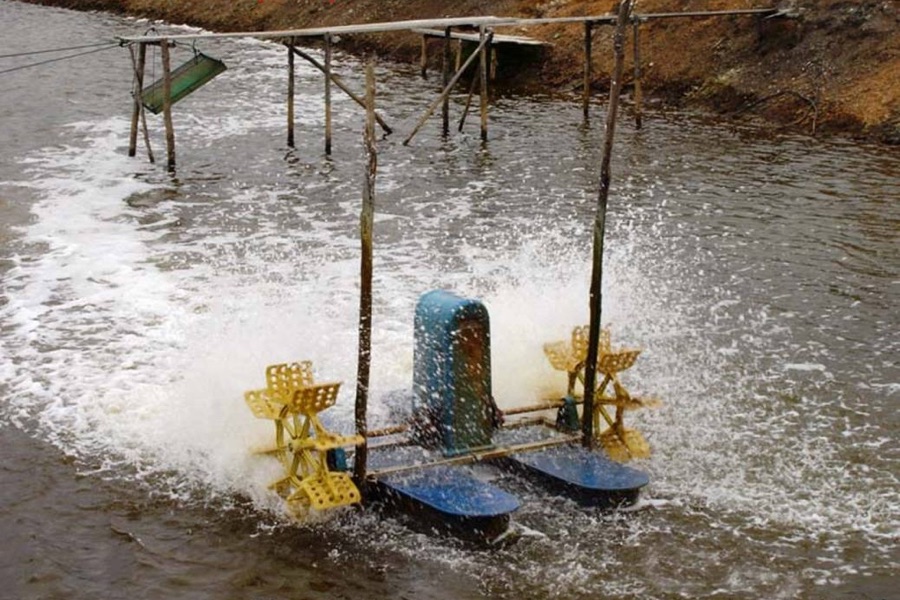
- Undersized or malfunctioning aeration equipment: Tripped breakers, worn paddlewheel blades, or clogged air diffusers reduce oxygen transfer when the pond needs it most. See why a fish pond aerator is not working properly.
What Should You Check First?
Never rely on water color alone to judge dissolved oxygen—a bright green pond can be supersaturated with oxygen at 3:00 PM and dangerously hypoxic at 5:00 AM:
- Measure dissolved oxygen with a calibrated meter at two times of day: Take readings just before sunrise (daily minimum) and mid-afternoon (daily maximum) at 30–50 cm below the surface and near the bottom.
- Watch fish behavior at dawn: If fish are gathering near the surface or inlets—see why fish gasp at the water surface—do not feed them until DO is measured and restored.
- Measure Secchi disk visibility (water transparency): Extremely low visibility (dense bloom) warns of wide day-night oxygen and pH swings.
- Verify water temperature: As pond water warms, its physical capacity to hold dissolved oxygen decreases while fish metabolic oxygen demand rises.
How to Tell the Possible Causes Apart
- High afternoon DO + very low dawn DO + pea-green water: Excessive phytoplankton biomass driving heavy nighttime respiration.
- Low DO both morning and afternoon + sudden change from green to brown/milky water: Algal bloom crash or pond turnover with high bacterial oxygen demand.
- Low DO localized in corners while aerator zone is high: Inadequate pond circulation or improper aerator placement.
What to Do Next
When dissolved oxygen drops into stressful ranges for your species, immediately withhold all feed, run mechanical aerators continuously through the night and overcast days, and avoid stirring up bottom mud. If clean, oxygenated well or surface water is available, flush water across the surface layer where fish are holding.
When to Get Professional Help
Do not apply copper sulfate or chemical herbicides during a low-oxygen event or dense summer bloom—killing phytoplankton all at once will trigger catastrophic bacterial oxygen depletion. Consult an aquaculture extension specialist or water quality technician to size aeration horsepower properly for your pond's standing fish biomass and daily feeding rate.