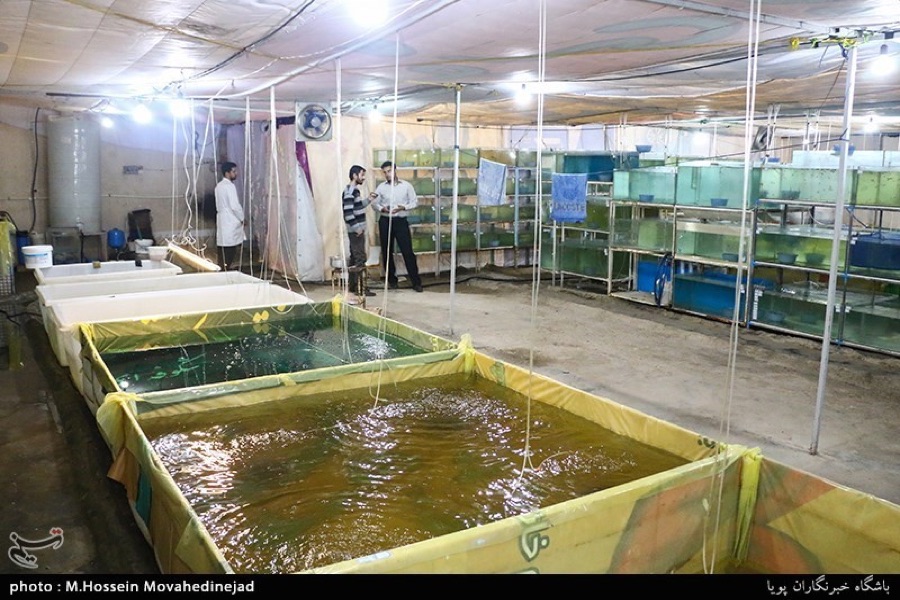
Because tank-raised fish depend on continuous water inflow to supply dissolved oxygen and flush out ammonia and carbon dioxide, a drop in flow rate requires prompt diagnosis. Following the water path from the source sump to the tank nozzle isolates the bottleneck in minutes.
What Could Be Causing This?
- Clogged pump suction strainer or intake screen: Leaves, snail shells, algae mats, or uneaten feed drawn against the intake screen starve the pump of water and cause cavitation.
- High head loss across mechanical or pressurized filters: In recirculating systems, a dirty bead filter, sand filter, filter sock, or clogged drum filter screen restricts flow downstream or starves the pump sump. See what causes filter problems in recirculating aquaculture systems.
- Low water level in the pump sump: If evaporation, leaks, or upstream filter blockage lowers the water level in the sump, the pump faces higher static lift or sucks in air (creating an airlock in high points of the pipe).
- Biofilm buildup or scale inside supply piping and nozzles: Over months of operation, bacterial slime, bryozoans, or mineral scale coat the inside of pipes and narrow spray bar holes.
- Bumped or partially closed manifold valves: When multiple tanks share a single main supply header, opening a valve wide on one tank steals pressure and flow from the tanks at the far end of the line.
- Pump impeller fouling or wear: Hair, netting threads, or debris wrapped around the pump impeller reduces discharge pressure even though the motor spins normally.
What Should You Check First?
- Check whether flow is weak in just one tank or across the entire manifold:
- If only one tank has weak flow while neighboring tanks on the same pump are strong, the pump is fine—check that tank's individual ball/gate valve and clean its inlet spray nozzle holes.
- If all tanks on the line have weak flow, inspect the shared main header, filter, pump strainer, and sump.
- Check sump water levels and filter pressure gauges: High pressure on a bead/sand filter gauge—or a low water level in the clean-water pump chamber—points directly to a dirty filter needing backwashing.
- Inspect the pump strainer basket through the clear lid: Look for trapped debris or swirling air bubbles (which indicate a suction-side air leak or low sump level).
How to Tell the Possible Causes Apart
- Pump sounds like it is pumping gravel (rattling/crackling noise) + weak flow: Suction blockage or low sump water level causing pump cavitation.
- High pressure gauge reading before the filter + weak flow at tank: Downstream restriction (clogged filter media, closed valve, or blocked spray bar).
- Flow recovers immediately after backwashing the mechanical filter: Normal solids loading exceeding the current backwash frequency.
What to Do Next
Keep supplemental tank aeration running while troubleshooting flow. Clean intake screens, backwash mechanical filters, bleed trapped air from high pipe loops, and brush out inlet spray nozzles. Once flow volume is restored, verify that the tank is rotating properly—review what causes poor water circulation in fish farming tanks.
When to Get Professional Help
Never open a pump strainer pot or disassemble plumbing while the pump is energized—water hammer or sudden startup can cause severe injury. Follow our guide on how to check a fish farming water pump and contact a qualified pump technician or electrician if the pump motor is overheating, tripping breakers, or leaking at the shaft seal.